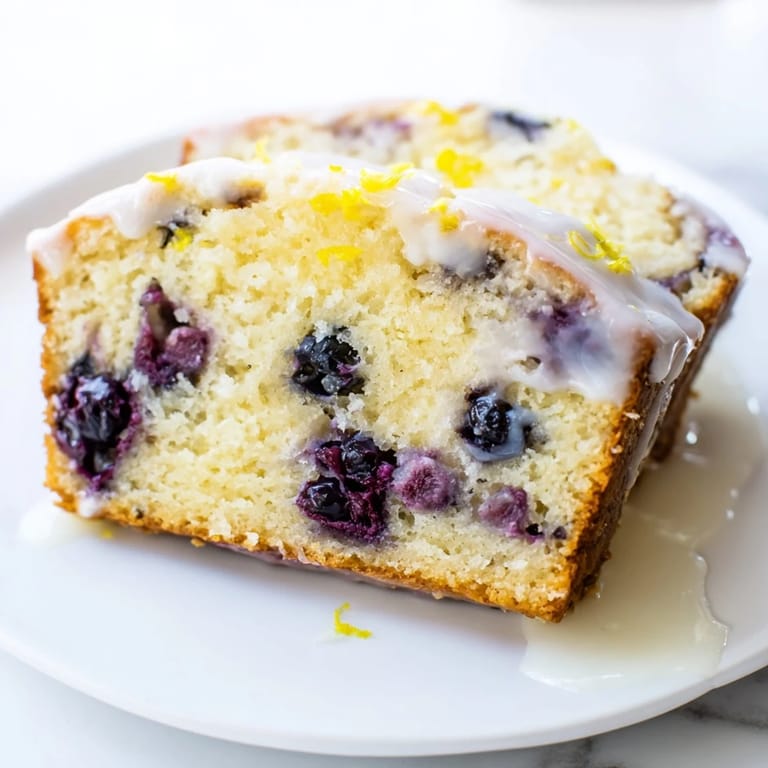
 Save to Pinterest
 There's something about a loaf cake that just works in the middle of a chaotic week. I discovered this blender version on a Tuesday morning when I was too impatient to drag out my mixer, and honestly, it changed how I think about baking. The first time I poured that silky blender batter into the pan, I could already smell the lemon and blueberries mingling in the oven's heat. What struck me most was how simple it felt—no fussy creaming, no separate bowls—yet the loaf came out impossibly tender and bright. Now it's my go-to when I need something comforting but don't have the energy for fuss.
I made this for my mom's book club last month, and I watched three different people ask for the recipe before they'd even finished their slice. What got me was how they kept talking about the texture—that tender, almost velvet crumb—and the way the tartness of the lemon made them want another bite. She told me later that one of her friends made it that same week for her own family. That's when I realized this cake does something special: it makes people feel cared for without being complicated.
Ingredients
- Eggs: Two large ones anchor the crumb and give you that tender structure that sets this apart from denser loaves.
- Plain Greek yogurt: This is your secret ingredient—it keeps everything moist and adds a subtle tang that brightens the lemon without needing extra acid.
- Vegetable oil: Half a cup ensures richness and prevents that dry crumb that flour-heavy cakes sometimes get.
- Lemon zest: One to two tablespoons, finely grated—this is where the bright personality comes from, so don't skimp or use bottled if you can help it.
- Fresh lemon juice: A quarter cup sounds like a lot, but it's essential; it ties the whole flavor story together.
- Vanilla extract: Just a teaspoon rounds out the flavors and keeps things from tasting too sharp.
- All-purpose flour: One and a half cups—measure by spooning and leveling, not scooping, or you'll end up denser than you want.
- Granulated sugar: Three-quarters cup sweetens without overwhelming the lemon notes.
- Baking powder and baking soda: Two teaspoons and half a teaspoon respectively; they're a team that lifts the cake just enough to make it tender.
- Fine sea salt: A quarter teaspoon enhances every other flavor in a way people usually can't put their finger on.
- Fresh blueberries: One cup—frozen ones work beautifully too, and they prevent that sinking issue when you toss them in a little flour first.
- Powdered sugar and lemon juice for glaze: Optional but worth it; the tartness and sweetness together create a perfect finish.
Tired of Takeout? 🥡
Get 10 meals you can make faster than delivery arrives. Seriously.
One email. No spam. Unsubscribe anytime.
Instructions
- Set the stage:
- Preheat your oven to 350°F and get a 9x5-inch loaf pan ready with a bit of grease and parchment paper. This takes five minutes and saves you from scraping stuck cake later.
- Blend the wet ingredients:
- Crack your eggs into the blender with the yogurt, oil, lemon zest, lemon juice, and vanilla. Blend until it's completely smooth and pale—you're looking for no streaks of egg white. This is where the real work happens, and it's genuinely just 30 seconds of blending.
- Add the dry ingredients carefully:
- Pour in the flour, sugar, baking powder, baking soda, and salt. Here's the key: pulse just until combined, maybe 8 to 10 pulses. Overmixing develops gluten and makes your cake tough, which defeats the whole purpose of being tender.
- Fold in the blueberries:
- Toss your blueberries with a tablespoon of flour to prevent them from sinking to the bottom, then gently fold them in with a spatula—don't use the blender. You want them distributed throughout, not pulverized.
- Transfer and smooth:
- Pour the batter into your prepared pan and use a spatula to smooth the top gently. The batter should look like soft, creamy clouds.
- Bake until golden:
- Bake for 50 to 55 minutes, watching around minute 45 for browning. If the top is getting too dark, lay a piece of foil over it loosely for the last 15 minutes. A toothpick inserted into the center should come out clean or with just a few moist crumbs.
- Cool with patience:
- Let the loaf rest in the pan for 10 minutes—this helps it set—then turn it out onto a wire rack to cool completely. If you cut into it while it's warm, the texture is still setting and you'll get uneven slices.
- Glaze if you like:
- Once cooled, whisk together powdered sugar and lemon juice until it's smooth, then drizzle it over the top. It'll set slightly and add that final touch of tartness.
 Save to Pinterest
 There was a morning last spring when I baked this loaf while my neighbor was working in her garden outside my window. The smell of it baking—all that lemon and butter mingling in the heat—drifted out through the screen, and she knocked on the door asking what smelled so good. We ended up sharing a slice on my kitchen steps with coffee, and she told me it tasted like what mornings should feel like. That's when I understood that this cake is more than just breakfast—it's permission to slow down.
Why This Works as Breakfast
There's something about this loaf that feels lighter than a typical dessert cake, even though it's plenty rich. The yogurt and lemon juice give it a brightness that doesn't feel heavy first thing in the morning, and the blueberries add nutrition that makes eating it feel a little less indulgent. I started making this on Sunday mornings specifically so I'd have slices to grab during the rush of the week—it pairs perfectly with coffee and somehow makes 7 a.m. feel intentional instead of hurried.
The Blender Method Advantage
The reason I keep coming back to this technique is that it eliminates the anxiety of traditional cake baking. You're not creaming butter and sugar until your shoulders hurt, not sifting flour, not managing three separate bowls. The blender does the heavy lifting, and all you really do is fold in berries and pour. I've found that this method creates a more uniform crumb because the wet and dry ingredients are emulsified smoothly rather than stirred together, which can leave dry pockets.
Variations and Twists
Once you understand how this cake works, you can play with it. I've made it with almond extract instead of vanilla for a deeper flavor, and I've swapped blueberries for raspberries when that's what was in the house. The structure stays solid because the ratio of wet to dry is so balanced. Even when I was experimenting with different ideas, the cake never let me down—it always came out tender and moist. Here's what I'd suggest if you're feeling creative:
- Add half a teaspoon of almond extract along with the vanilla for a subtle nod to something more sophisticated.
- Substitute frozen raspberries or blackberries for the blueberries and adjust expectations slightly since they're more delicate.
- Make it dairy-free by using coconut yogurt; the flavor will shift slightly but the cake will still be tender and lovely.
 Save to Pinterest
 This loaf has become my answer to so many moments—when someone unexpected drops by, when I need comfort food that doesn't require hours of planning, when I want to feel like I baked something impressive without the stress. It's taught me that some of the best foods are the ones that fit into real life without requiring you to turn your kitchen upside down.
Recipe Questions
- → Can frozen blueberries be used?
Yes, frozen blueberries can be added directly without thawing to prevent excess moisture and maintain texture.
- → How to prevent blueberries from sinking?
Toss the blueberries in a small amount of flour before folding them into the batter to keep them evenly distributed.
- → What is the baking temperature and time?
Bake at 350°F (175°C) for about 50-55 minutes until a toothpick comes out clean.
- → Can this loaf be made dairy-free?
Yes, substitute plain Greek yogurt with coconut yogurt and use a neutral oil for a dairy-free option.
- → Is a glaze necessary?
The lemon glaze is optional but adds a bright, sweet finish that complements the loaf’s flavors nicely.
- → How to store the loaf?
Store at room temperature in an airtight container for up to two days or refrigerate for longer freshness.